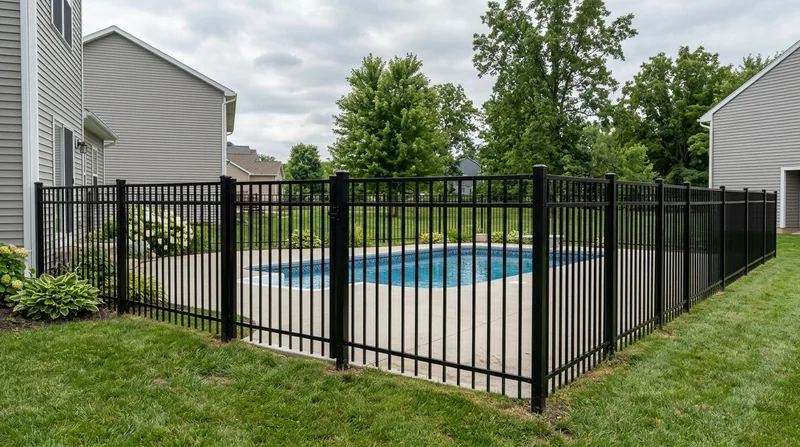




Pool fence installation in Buffalo requires more than standard fencing knowledge. Buffalo's deep freeze cycles, heavy lake-effect snow, and the specific pool barrier codes that apply in your neighborhood mean posts must be set well below the frost line, gates must close reliably after winter heave, and every installation must meet the state and local regulations that govern pool safety. We work from your site's requirements first, then build the barrier to code with aluminum, mesh, or glass systems that survive Buffalo winters and keep the latch working year after year.
Pools are common in Buffalo backyards, from older Allentown Victorians with small in-ground shells to the newer subdivisions in Clarence, Lancaster, and Orchard Park where above-ground and deck pools sit on level ground. The problem is the same everywhere here: frost heave pushes posts up, plowed snow banks collapse against fence lines, and gate hinges bind when the frame shifts. A pool fence that passes inspection in June can fail to latch by January if it was not set deep enough or braced properly. We install to hold through that cycle, and we explain what depth, what bracing, and what gate hardware it takes before we dig the first hole.
This page covers aluminum, mesh, and glass pool barriers for Buffalo-area backyards, the code requirements that apply at your address, how we set posts and hang gates so they stay in working order, and what you should expect to pay. Call (716) 274-5875 for a free estimate, or read on to understand the work.
Why Pool Fence Installation Matters in Buffalo's Freeze-Thaw Cycle
Buffalo sits at the eastern end of Lake Erie and the head of the Niagara River, which means six months of winter, deep frost penetration into the ground, and the freeze-thaw heave that pushes fence posts upward every spring. A pool fence installed in shallow ground will shift, gates will bind, and the self-closing latch that was snug in July will hang open by March. New York state pool barrier codes require a specific height and gap closure, and they assume the fence stays in place. When frost heaves the posts, the code requirement fails even if the fence was built correctly.
We set posts below the frost line in Buffalo, which is typically 42 to 48 inches depending on the exact location and soil type. We use concrete footings that resist the heave pressure, and we brace gates and corner posts with anti-sag hardware so they stay plumb and the latch stays true. The cost is higher than shallow setting, but the difference between a gate that closes reliably and one that hangs open is the difference between code compliance and a failed inspection.
- We set posts below the frost line to prevent heave and maintain gate function through winter.
- We install self-closing, self-latching hardware that works even after the frame shifts.
- We verify the pool barrier code that applies at your address before we begin.
- We brace aluminum and mesh systems with anti-sag bracing to keep the fence plumb and the gaps within code.
Getting the depth and bracing right the first time means no callbacks, no failed inspections, and no gate hanging open when your pool is closed.
Key info: New York pool barrier codes are enforced by your local building department and vary by municipality. Buffalo, Cheektowaga, Tonawanda, and West Seneca each have slightly different standards for height, gap closure, and gate hardware. We walk those requirements with you before a single post is set. See your local authority's website or call us at (716) 274-5875 to verify the code that applies to your property.
For more on how local codes affect fence work, see our guide to fence repair in Buffalo, which covers the same frost-heave and winter-damage issues that affect pool barriers.
How We Install Pool Fences in Buffalo: From Site Walkthrough to Code Compliance
Every pool fence starts with a site visit and a clear conversation about what code applies at your address, what height and gap closure the code requires, what material works best for your yard, and what the cost will be. We do not assume a standard installation. Buffalo yards vary widely: some sit on flat glacial lake clay, others on rolling till soil in the Southtowns; some have mature maples and oaks that shade the pool area, others sit in open subdivisions with no tree interference. We measure the pool perimeter, identify the frost line depth for your soil, check for utility lines with an 811 locate, and then propose a post spacing, bracing strategy, and gate location that holds through winter and passes inspection.
Our process is straightforward: we walk the site with you, confirm the code, get your approval on materials and placement, call 811 for utility locates, set posts in concrete below the frost line, install the barrier panels or mesh, hang the gate with self-closing and self-latching hardware, and verify that the latch works and the gaps meet code. We test the gate function in your presence before we leave.
- We visit the site, measure the pool perimeter, and confirm the pool barrier code that applies at your address.
- We call 811 for a utility locate before digging any post holes.
- We set posts in concrete below the frost line, typically 42 to 48 inches in Buffalo soil.
- We install aluminum, mesh, or glass panels with anti-sag bracing and corner reinforcement.
- We hang the gate with self-closing, self-latching hardware and test it in your presence.
- We verify that the fence height, gap closure, and gate function meet the local pool barrier code.
The result is a pool fence that holds through Buffalo winters, a gate that closes reliably, and documentation that shows your installation meets code.
Example: A homeowner in Williamsville had an above-ground pool on a level lot with no nearby trees. We measured 120 linear feet of perimeter, called 811 and found no utilities in the post-hole zone, set 12 posts in concrete at 48 inches depth with corner bracing, installed black aluminum panels with a 4-inch gap closure, and hung a self-closing gate at the deck access point. The job took two days. The homeowner's building department inspector verified the installation against the Williamsville pool barrier code and signed off the same week.
For a detailed look at how we handle gate installation and hardware in other applications, see gate installation and repair in Buffalo.
Pool Barrier Materials and Methods
| Material | Description | Best for Buffalo |
|---|---|---|
| Aluminum | Powder-coated aluminum panels and posts, typically black or bronze, with no maintenance and long life in cold climates. | Most common choice for Buffalo pool fences. Resists road salt, does not rot or splinter, and survives freeze-thaw cycles without warping. |
| Mesh | Removable or permanent mesh panels that provide visibility into the pool area and allow wind and snow to pass through without catching. | Good for seasonal pools and yards where snow load or wind load is a concern. Easier to remove for pool closing. Lower initial cost. |
| Glass | Tempered glass panels in aluminum frames, offering full visibility and a modern appearance. | Premium option for new homes in Clarence, Lancaster, and Orchard Park. Requires careful handling in winter (thermal stress from salt spray and temperature swings). |
| Self-Closing Gate | Hydraulic or spring-loaded gate that closes and latches automatically, with a latch that engages without manual action. | Required by code in most Buffalo jurisdictions. Must be set on posts deep enough to stay aligned after frost heave. |
All materials meet New York pool barrier codes when installed correctly. Aluminum is the most common in Buffalo because it survives salt spray, freeze-thaw, and heavy snow loads without maintenance. Mesh is lighter and more affordable for seasonal pools. Glass offers visibility but requires more careful installation in Buffalo's winter climate. We recommend aluminum for most Buffalo homes and will discuss alternatives based on your pool type, yard layout, and budget.
Pool Fence Installation Cost in Buffalo: What to Expect
Pool fence installation in Buffalo typically starts at $34 per linear foot for aluminum panels with self-closing gate hardware, posts set below the frost line, and concrete footings. The total cost depends on the perimeter of your pool, the material you choose (aluminum, mesh, or glass), the depth of the frost line, the soil type, and any bracing or reinforcement needed for corner posts or wind-load areas. A typical above-ground pool in Buffalo requires 80 to 150 linear feet of fencing, which puts the cost in the range of $2,700 to $5,000 before any gate upgrades or complex site conditions.
Several factors move the cost up from the starting point. If your yard has mature trees, we may need to work around root systems or adjust post spacing. If the soil is rocky or clay-heavy (common in Buffalo), excavation takes longer. If your pool sits on a slope or in a corner of the yard, the fence layout becomes more complex and may require additional bracing. If you choose glass instead of aluminum, the cost per linear foot increases significantly because the material is more expensive and the installation requires more precision. Corner posts with anti-sag bracing add cost but are necessary in Buffalo to prevent heave-related misalignment.
We recommend getting two or three estimates from local contractors so you can compare material choices, post-setting depth, and warranty terms. A low estimate may reflect shallow post setting or inadequate bracing, which will fail in Buffalo's freeze-thaw cycle. Our estimates are free and include a site walkthrough, a clear explanation of the code that applies at your address, and a detailed line-item breakdown of materials and labor. Call Buffalo Fence at (716) 274-5875 for a free estimate, or visit our pricing page for more detail on cost factors and material options.
Real example: A homeowner in West Seneca with a 110-linear-foot above-ground pool on level ground chose black aluminum with a self-closing gate and posts set 48 inches deep. The estimate was $3,850. A homeowner in Kenmore with a 90-linear-foot in-ground pool on a slope with mature oaks required additional corner bracing and slightly deeper post setting for the heavier soil. That estimate was $3,200. The difference reflects site conditions, not material choice.
Pool Fence Installation Near Me: What Buffalo Homeowners Should Know Before Hiring
Hiring a fence contractor for pool barrier installation is not the same as hiring one for a backyard privacy fence. Pool fences are code-driven, inspected by the local building department, and directly responsible for a safety outcome. Before you call, understand what the law requires and what questions to ask. Fence work licensing in New York is set by county and varies across the state; some counties require a licensed general contractor for jobs above a certain dollar threshold, while others do not. Check with your local building department or county assessor to learn what applies to your address. Any contractor you hire should carry general liability and workers' compensation insurance and be able to provide a certificate of insurance on request.
Ask any contractor you interview about post-setting depth, frost line research, and how they handle Buffalo's winter heave. Ask whether they call 811 for utility locates before digging. Ask to see examples of pool fences they have installed in Buffalo or nearby towns, and ask for references from homeowners whose fences passed inspection. Ask about the warranty on hardware and materials. Ask whether they verify code compliance with the local building department before they leave the site. If a contractor cannot or will not answer these questions, find another one.
- We call 811 for utility locates before digging any post holes, as required by New York law.
- We set posts below the frost line to prevent heave and gate misalignment in Buffalo winters.
- We verify the pool barrier code that applies at your address and install to meet it.
- We test the gate function and document the installation so you have proof of code compliance for your building department.
- We work in Buffalo, Cheektowaga, Tonawanda, West Seneca, Kenmore, Williamsville, and throughout the greater Buffalo area.
Getting multiple estimates, checking references, and asking about post depth and frost line handling will help you choose a contractor who understands Buffalo's climate and will deliver a fence that holds.
For more information on how we handle other fence installations and repairs in Buffalo, visit our aluminum and ornamental iron fencing page, or call us at (716) 274-5875 for a free estimate on your pool fence project.
Pool Fence Installation in Buffalo: Pricing Guide
| Service | Price | Details |
|---|---|---|
| Aluminum pool fence, standard installation | Starting at $34/ft | Posts set 42 to 48 inches deep, self-closing gate, panels installed to local pool barrier code |
| Mesh pool fence, removable or permanent | Starting at $24/ft | Lower cost option for seasonal pools, allows wind and snow pass-through, easier removal for pool closing |
| Glass pool fence, tempered panels | Starting at $48/ft | Premium appearance, full visibility, requires careful installation in Buffalo winters, thermal stress management |
| Complex site or additional bracing | On estimate | Sloped terrain, mature trees, corner reinforcement, or unusual pool shape requires site visit and custom proposal |
| Travel and utility locates | Included | No separate mileage charge in Buffalo and surrounding areas; 811 utility locates required by law, included in estimate |
| Free estimate | No obligation | Response within 24 hours, site walkthrough, code verification, and detailed line-item breakdown before you commit |
Indicative pricing, the exact cost depends on square footage, finish, and site access. Free personalized estimate within 24h at (716) 274-5875.


