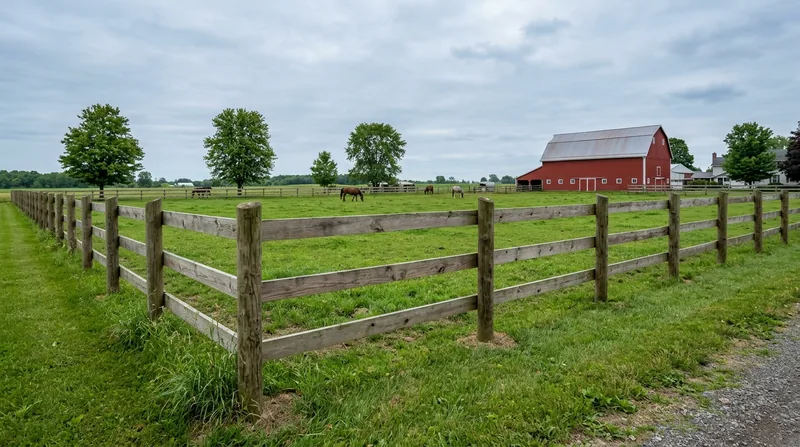




Farm fence installation in Buffalo demands more than a straight line and some posts. The flat glacial plain from Buffalo south through West Seneca and Lancaster, and the rolling till country toward the Southtowns and Lockport, require fencing built to handle deep frost heave, heavy lake-effect snow loads, and the seasonal wet that rots posts at the ground line. Ranch rail, no-climb horse fence, field wire and pipe fencing across Erie, Niagara, Genesee and Wyoming counties need braced corners set deep, proper post spacing over long runs, and gates sized for trailers and equipment. We set posts in concrete below the frost line, brace high-stress corners, and run straight lines across acreage so your perimeter holds through the thaw cycles and wind gusts that push lesser fence over.
Why Farm & Ranch Fencing Matters in Buffalo's Agricultural Landscape
Greater Buffalo and the surrounding counties still support working farms, hobby acreage, horse properties and land that needs secure perimeter fencing. Unlike residential privacy fence on a tight lot, farm and ranch fencing spans hundreds of linear feet over open ground, crosses variable terrain, and must contain livestock or mark property lines against seasonal shifts and weather stress. Post rot at the ground line is the dominant failure mode here: our wet springs, freeze-thaw cycles, and snow piled against fence lines by plows all drive moisture into the post base. Proper drainage, concrete set below frost depth, and material choice make the difference between a fence that holds for a decade and one that leans by year three.
- Ranch rail and split rail fencing define property lines and contain livestock without visual obstruction across open acreage.
- No-climb horse fence combines horizontal cable or woven wire with sturdy posts so horses cannot catch hooves or climb over.
- Pipe and field wire fencing handle rough terrain and high-stress corners where livestock push hard against the perimeter.
- Gates sized for equipment and trailers allow farm access without dismantling fence sections.
- Braced corners set deep in concrete resist the heave and wind stress that topple corner posts in Buffalo's climate.
A well-built farm fence pays for itself in contained livestock, clear boundaries, and years of service before any major repair work is needed.
Key info: New York State requires an 811 utility locate before any digging on your property. Call 811 or visit call811.com at least three business days before post-hole digging begins so underground gas, electric, water and telecommunications lines are marked and you avoid costly damage.
How We Build Farm & Ranch Fencing Across Western New York
Our process starts with understanding your land, your animals or boundary needs, and the specific terrain we are working with. We walk the property, identify high-stress points like gates, corners and slope changes, and plan post spacing and bracing that matches your soil and climate. We pull a 811 locate, set posts in concrete below the frost line, brace corners where livestock or wind load is highest, and run material straight and level even across rolling ground. Whether it is ranch rail across a Clarence horse property, no-climb fence around a West Seneca pasture, or pipe fencing on rough Southtowns acreage, the method stays the same: deep set, proper spacing, and bracing that holds.
- Site visit and property walk to identify terrain, soil conditions, animal containment needs and gate locations.
- Call 811 for utility locate; mark all underground lines before digging begins.
- Dig post holes below the frost line (typically 42 to 48 inches in Buffalo area) and set posts in concrete.
- Install bracing at corners and high-stress points so posts resist heave and livestock pressure.
- Run rail, cable, wire or pipe material and hang gates sized for your equipment and animals.
- Walk the completed fence with you and explain maintenance points that keep it sound year to year.
Local example: A 300-foot no-climb horse fence around a Williamsville property with a gate for trailer access, braced at two corners where the fence changes direction. Posts set 48 inches deep in concrete, spaced 6 feet apart, with horizontal cable strung between posts and a top rail for visual definition. Total time on site: 3 to 4 days depending on ground conditions and rock.
Our crews handle the work directly. No subcontractors, no delays waiting for another company to show. You get the same people who built your fence if you need repair or adjustment later. See our gate installation and repair page for details on equipment and trailer gates.
Farm & Ranch Fencing Methods and Materials
| Approach | Description | Best for |
|---|---|---|
| Ranch Rail | 2x6 or 2x8 horizontal boards nailed to 4x4 posts, typically 2 or 3 rails high. Cedar or pressure-treated pine. Classic appearance, moderate cost, low maintenance. | Property lines, horse pastures, visual definition across open acreage without full containment of small livestock. |
| No-Climb Horse Fence | Horizontal cable or woven wire mesh (typically 2x4 opening or smaller) secured to sturdy posts with top rail. Prevents hooves from catching and horses from climbing over. | Equine containment, pasture subdivision, high-value animals where safety and visibility matter equally. |
| Pipe Fencing | Steel pipe (typically 1.5 to 2 inch diameter) welded to 4x4 or steel posts. Galvanized or powder-coated finish. Extremely durable, high initial cost, minimal maintenance. | High-stress corners, rough terrain, livestock that push hard, long-term investment properties where replacement cost justifies the upfront spend. |
| Field Wire & Split Rail Combo | Split rail posts and top rail with field wire (typically 12.5 gauge) stretched between. Affordable, classic appearance, good for cattle and sheep, requires periodic tensioning. | Mixed livestock, budget-conscious acreage, rural aesthetic where visibility and light passage are desired. |
| Barbed Wire | High-tensile barbed wire (typically 4 or 5 strand) stretched between wooden or steel posts. Lowest initial cost, requires regular inspection and re-tensioning, visual deterrent for cattle. | Large pastures, cattle containment, boundary marking where appearance is secondary to function and cost is the primary constraint. |
Each method has a place depending on your animals, terrain, budget and long-term maintenance tolerance. We recommend the material that gives you the best service-to-cost ratio for your specific situation.
Farm & Ranch Fencing Cost in Buffalo: What to Expect
Ranch rail and split rail fencing typically starts at $12 to $18 per linear foot installed, depending on material grade (cedar versus pressure-treated pine), rail height, and post spacing. No-climb horse fence runs $15 to $25 per linear foot because the cable or mesh material and the labor to string it tight add cost. Pipe fencing is the highest upfront investment, starting at $20 to $35 per linear foot or more, but it lasts decades with minimal maintenance. Field wire and barbed wire are the most affordable options, ranging from $8 to $14 per linear foot, though they require periodic tensioning and inspection.
The total cost for your job depends on several concrete factors: the length of fence (a 500-foot run spreads setup and travel costs over more linear feet than a 100-foot job); terrain and soil type (rocky ground or clay takes longer to dig); post spacing and bracing (a high-stress corner with double bracing costs more than a straight run); gate count and size (each gate adds labor and material); and access for equipment (rough acreage or steep slopes may require hand-digging some holes). A property in Orchard Park with good access and level ground will cost less per foot than a rolling Southtowns property where we dig by hand and brace heavily.
Get 2 to 3 estimates from different contractors so you understand what is included in each price. Ask whether posts are set in concrete or tamped, whether bracing is included at corners, and what warranty or guarantee covers the work. Visit our pricing page for more detailed guidance on cost factors and what moves the needle on your final estimate.
Call us at (716) 274-5875 for a free, no-obligation site visit and estimate. We respond within 24 hours and walk your property to give you a realistic price based on what we see, not a generic formula.
What to Look for When Hiring a Farm Fence Contractor Near Buffalo
Hiring the right contractor matters because farm fencing is a long-term investment and a bad install costs you money and frustration for years. Start by asking whether the contractor carries general liability and workers compensation insurance and request a certificate of insurance before work begins. In New York, fence contracting licensing varies by county and project scope. For most residential and farm fencing in Erie and Niagara counties, no specific fence contractor license is required; however, projects above certain dollar thresholds may require a licensed general contractor. Confirm the permitting rules with your local building department before you bid the job.
Second, check for references from similar jobs: ask the contractor for 2 to 3 recent farm or ranch fencing installations and call those customers. Ask how the fence is holding up, whether the contractor was responsive during and after the job, and whether they came back to fix any issues. A contractor who stands behind their work is worth the conversation.
Third, understand permit requirements for your specific property. Some municipalities require a fence permit; others do not. HOA rules and deed restrictions in master-planned communities often limit fence height, material and color regardless of what the town allows. If your property is in a historic district or overlaps protected land, check with the planning department before you start. We work with you to navigate these rules, but the final authority is your local building or planning department and your HOA if one applies.
Finally, verify that the contractor pulls a 811 utility locate and has a clear plan for post depth, bracing and material choice. A contractor who rushes through these details or dismisses them is cutting corners that will cost you later. Contact us for a free estimate and we will walk through every detail so you know exactly what you are getting.
Farm & Ranch Fencing in Buffalo: Pricing Guide
| Service | Price | Details |
|---|---|---|
| Ranch Rail Fencing | Starting at $12/ft | Two or three horizontal rails on 4x4 posts; cedar or pressure-treated pine; includes post set in concrete and basic bracing |
| No-Climb Horse Fence | Starting at $15/ft | Horizontal cable or woven wire with top rail; post spacing 6 feet; includes concrete set and corner bracing for containment |
| Pipe Fencing | Starting at $20/ft | Steel pipe welded to posts, galvanized or powder-coated; extreme durability; high-stress corners and rough terrain; long-term investment |
| Field Wire or Barbed Wire | Starting at $8/ft | Split rail or wooden posts with field or barbed wire; affordable option for cattle and boundary marking; requires periodic tensioning |
| Gates and Equipment Access | On estimate | Trailer gates, equipment gates, and specialty hinges vary by size and material; typically $800 to $2,500 depending on width and load |
| Free Estimate | No obligation | Site visit, property walk, and written estimate within 24 hours; call (716) 274-5875 to schedule |
Indicative pricing, the exact cost depends on square footage, finish, and site access. Free personalized estimate within 24h at (716) 274-5875.


